
Build the Metabolism. Build the Muscle. Cut the Fat?
The proposed sequence at a glance
An interesting research question connects these three areas: metabolic signaling, muscle biology, and fat metabolism. The quoted week ranges below describe a proposed online sequence. The sources reviewed do not establish its timing, safety, or effectiveness in humans.
- MOTS-c — “8–12 weeks”
- SLU-PP-332 — “4–8 weeks”
- AOD-9604 — “12–16 weeks”
The proposed pause: The same proposal mentions “equal or greater time off,” with “4–8 weeks” as an example. Those descriptions leave the intended break length unclear; a safe transition or restart interval remains an unanswered research question.
Source context: the supplied online reference. The scientific papers below examine individual compounds, rather than testing this sequence or its phase lengths.
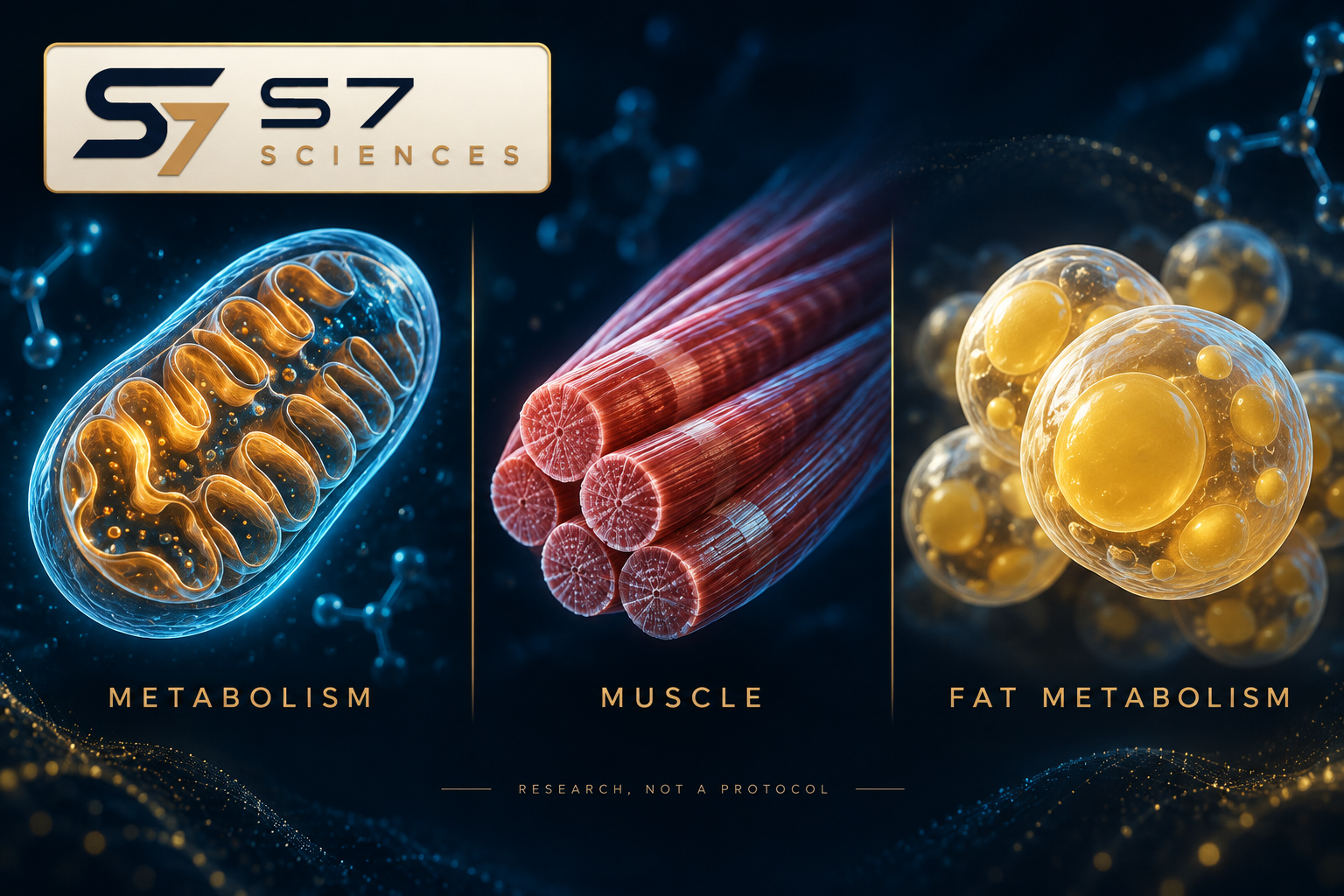
Exploring the connections between energy, muscle, and fat metabolism through MOTS-c, SLU-PP-332 and AOD-9604 research.
The headline describes an appealing goal, not a demonstrated outcome of these compounds. The research below does not establish that this sequence builds muscle or produces safe, reliable fat loss.
S7 Sciences • Research spotlight • Reviewed September 11, 2026
Featured original research
MOTS-c is an exercise-induced mitochondrial-encoded regulator of age-dependent physical decline and muscle homeostasis
Joseph C. Reynolds and colleagues · Nature Communications · January 20, 2021
“In humans, exercise induces endogenous MOTS-c expression…”
This study connects naturally occurring MOTS-c with exercise in humans and investigates administered MOTS-c in mice. It does not test the three-compound sequence discussed below.
Why this idea captures the imagination
Energy regulation, muscle function, and fat metabolism are connected parts of a much larger biological story. That connection helps explain the interest in a proposed sequence circulating online: MOTS-c, followed by SLU-PP-332, and then AOD-9604.
The appeal is easy to understand: three distinct research interests, brought together in one framework. It gives readers an accessible way to explore the science—and researchers a question that could be tested.
The most interesting question is whether order itself could make a meaningful difference. Answering it would require evidence that the sequence offers a benefit beyond the individual compounds, alongside careful evaluation of safety.
In the research reviewed for this article, we did not identify a published human study validating that exact sequence, its proposed cycle lengths, or a required washout period.
The compounds bring different kinds of biology to the discussion: MOTS-c and AOD-9604 are peptides. SLU-PP-332 is a synthetic small molecule, not a peptide. Its original development research describes a compound designed to activate estrogen-related receptors involved in metabolic regulation. Cyrielle Billon and colleagues, 2023
MOTS-c: Exploring the cell’s energy conversation
MOTS-c is a short peptide encoded within mitochondrial DNA. Its story invites us to see mitochondria as more than energy producers: they also participate in the signals that help cells adapt to changing conditions.
In foundational experiments, Changhan Lee and colleagues linked MOTS-c with metabolic pathways involving AMPK, an important cellular energy sensor. Administering MOTS-c improved measures of insulin sensitivity and protected against diet-induced obesity in mice. These findings give researchers a concrete reason to investigate its potential metabolic role. Lee and colleagues, 2015
Later work by Reynolds and colleagues found that exercise increased naturally occurring MOTS-c in human muscle and circulation. Separate experiments in the same paper found improved physical performance in mice given MOTS-c.
Together, these observations create an intriguing connection between exercise and the body’s own signaling. The next question is different: what happens when people receive MOTS-c as a drug? Measuring the naturally occurring peptide cannot answer that on its own. Reynolds and colleagues, 2021
Human investigation offers a way to examine those possibilities directly. A sponsor-submitted ClinicalTrials.gov record describes a randomized MOTS-c study in adults with prediabetes and overweight or obesity. At this review, the record listed recruitment and no posted results. A registered study helps make the research question visible; its results are still needed to assess effectiveness and safety. Hudson Biotech, NCT07505745
Whether MOTS-c could influence the response to a later intervention is another question for future research. A clinical “priming” effect has not been demonstrated.
SLU-PP-332: A closer look at muscle-energy signaling
SLU-PP-332 offers researchers a way to investigate estrogen-related receptors, or ERRs. Activating these receptors affects the regulation of genes involved in energy metabolism.
Initial studies found changes in muscle-cell respiration and improved endurance in mice. These observations explain the term exercise mimetic: the molecule reproduces certain exercise-associated responses in experimental systems. That makes it an interesting research tool, while leaving its effects in people—and any comparison with exercise’s broader benefits—to be established. Billon and colleagues, 2023
A subsequent study examined mouse models of obesity and metabolic syndrome. Researchers reported increased energy expenditure and fatty-acid oxidation, reduced fat accumulation, and improved insulin sensitivity in relevant experimental groups. Billon and colleagues, 2024
This is where the conceptual connection with MOTS-c becomes interesting: both are studied for effects on energy-related biology, but through different mechanisms.
A future sequencing study could ask whether those mechanisms interact in a useful way. The existing experiments do not show that earlier MOTS-c exposure improves SLU-PP-332’s effectiveness or safety, and they do not establish a need to use one before the other.
AOD-9604: What fat-metabolism research can teach us
AOD-9604 is a modified fragment derived from human growth hormone. Its development explored a focused question: could a fragment influence fat metabolism without reproducing the full hormone’s effects? Experiments in obese rats provided evidence of biological activity and a basis for further investigation. F. M. Ng and colleagues, 2000
The move into human studies adds an important part of the story: biological activity and meaningful weight loss are separate outcomes.
In its 2024 review, FDA described a larger randomized oral AOD-9604 trial that did not demonstrate statistically significant weight loss compared with placebo. FDA concluded that the available evidence did not support its effectiveness for treating obesity. This was not a trial of AOD-9604 following MOTS-c and SLU-PP-332. U.S. Food and Drug Administration, 2024 briefing document
A separate publication by Heike Stier, Evert Vos and David Kenley summarized six human trials and reported favorable tolerability under the conditions studied. The paper disclosed commercial relationships with the developer. Those observations contribute to the safety discussion under the conditions studied. They do not establish weight-loss effectiveness, long-term safety across formulations, or safety within a multi-compound sequence. Stier, Vos and Kenley, 2013
The value of this research includes learning which laboratory signals translate into meaningful human outcomes—and which do not. AOD-9604’s research history is informative, but it is not established as an effective obesity treatment or a final “fat-loss phase.”
How research could test the next chapter
The proposed sequence becomes more useful scientifically when it is turned into a clear, testable question. A well-designed study would separate the effect of order from the effects of the individual compounds, lifestyle changes, and time.
Appropriate comparison groups could show whether the sequence performed differently from individual interventions or a different order. Tracking adverse effects and the persistence of any benefits would help build a fuller picture.
That approach would help answer the “priming” question directly. Improvement observed during a sequence, on its own, cannot establish that an earlier compound prepared the way for the next.
Timing deserves the same careful study. Questions about recovery between exposures, sufficient washout, or sequential versus overlapping use need evidence of their own; a suggested break does not establish a receptor reset or a safe interval.
These are specific questions that a thoughtful research program could investigate.
Building a complete picture: safety and product quality
A complete understanding includes both a molecule’s biology and the quality and safety of the product being studied. Terms such as “natural,” “mitochondrial,” and “growth-hormone fragment” describe origins or relationships; they are not evidence that a marketed product is safe.
FDA has identified concerns involving potential immune reactions, peptide-related impurities, and limited safety information for compounded products containing MOTS-c or AOD-9604. Addressing these questions is part of translating interesting laboratory findings into reliable clinical knowledge. Promising laboratory results alone cannot resolve those safety gaps. U.S. Food and Drug Administration, compounding safety information
This article explores a proposed sequence and the evidence behind it. It is an educational review, not an individualized treatment plan; medical decisions belong with a qualified clinician.
The S7 Sciences takeaway: curiosity with a clear view of the evidence
The real opportunity is to understand how energy sensing, exercise-related gene regulation, and fat metabolism connect. Each line of research contributes a different perspective.
Bringing those perspectives together can inspire useful research questions. A clinical benefit from this particular sequence remains unestablished.
The proposed order is best understood as a question for investigation, with its timing, benefits, and safety still to be tested.
MOTS-c draws attention to mitochondrial signaling. SLU-PP-332 opens a window into preclinical ERR biology and muscle metabolism. AOD-9604’s development illustrates how human trials help test the promise of a biological mechanism.
A curious, evidence-led approach allows room for both discovery and honest uncertainty. That is what makes this an engaging scientific story—and a worthwhile one to keep following.
Explore the sources and background discussion
The original reference names publishers without providing exact source links. Related background pages from those publishers include:
- FormBlends Editorial Research: MOTS-c cycling discussion.
- Newtropin: Comparison of SLU-PP-332 and MOTS-c.
- Beverly Hills Rejuvenation Center: AOD-9604 therapy overview.
These commercial and clinic-authored pages provide context for the wider discussion. For scientific conclusions, the article draws on the original research and regulatory review linked throughout; the background pages do not validate the proposed sequence.
Educational research overview only—not medical advice or a recommendation to use, combine, or sequence these compounds.