

S7 Sciences
🇺🇸⌄
21+

Restricted research comparison

Before entering S7 Sciences

Please confirm both statements below. Access is limited to adults who understand the strict research-use restriction applied to the third-party product listings compared on this site.

Required confirmations
I cannot confirm — exit site

Important safety information: S7 Sciences is an affiliate comparison site, not a seller or medical provider. Linked products are not intended for injection or other administration. Please review the complete Terms of Use.

Independent affiliate comparison · Research use only · Not medical advice
S7 Sciences
ProductsOffersCalculatorCOAResourcesSocial MediaAboutContactAffiliatesInternational Vendors
Comparison Cart0
Comparison cart
0 items

No products added yet.

Open full comparison cart
🇺🇸⌄

The selected language applies across the complete S7 Sciences site. Exact product names, vendor names, strengths, prices, coupon codes, source titles, authors, quotations, and destination links remain unchanged.

Resources/Featured article

One paper contains several kinds of evidence. Keeping them separate makes its contribution easier to understand.

By S7 Sciences Research DeskUpdated September 16, 20262 min read
S7 Sciences
The short version

Measuring a naturally occurring peptide after exercise is different from testing it as a human treatment.

Featured original sourceS7 adaptation and commentary

MOTS-c is an exercise-induced mitochondrial-encoded regulator of age-dependent physical decline and muscle homeostasis

Joseph C. Reynolds, Rochelle W. Lai, Jonathan S. T. Woodhead and colleagues

Nature Communications · January 20, 2021

“exercise induces endogenous MOTS-c expression”

The article below is an original S7 Sciences summary and analysis. The quoted passage is brief and attributed; the complete original remains with its author and publisher.

Read the complete original source

Different experiments answer different questions

Reynolds and colleagues examined MOTS-c through human exercise observations, mouse experiments and cell work. In the human portion, ten healthy sedentary young men performed bicycle exercise while researchers measured naturally occurring MOTS-c in muscle and circulation. These participants were not given MOTS-c as a treatment.

Separate experiments administered MOTS-c to mice and examined physical performance and age-related muscle biology. Cell experiments explored stress responses. Together, these approaches offer mechanistic leads, but the human measurements do not demonstrate that administering MOTS-c improves endurance, slows aging or is safe in people.

Keep the subject, intervention and outcome on one line

S7’s practical reading method is to write three labels for each experiment: who or what was studied, what was changed, and what was measured. Keep those labels together when discussing the result. Otherwise, the human participants from one part of a paper can accidentally lend credibility to an intervention tested only in another species.

A paper can be valuable without settling a treatment question. Its most useful contribution may be a better hypothesis or a more precise next experiment. Ask what new evidence would be needed for the particular claim you are evaluating instead of treating every positive observation as interchangeable proof.

Respect the gap between a signal and a product

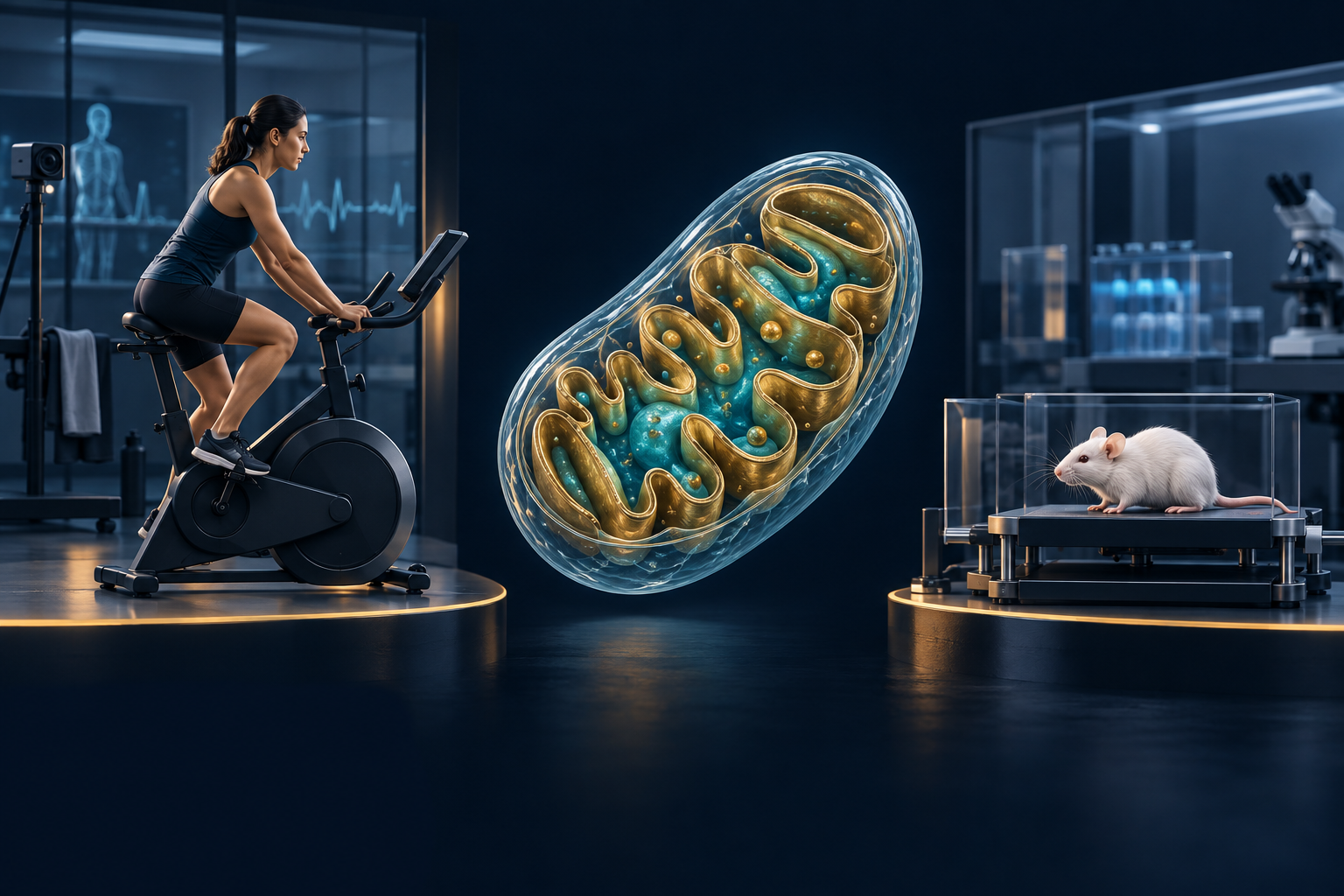
This is an educational research review, not an exercise-enhancement recommendation or instructions for using MOTS-c. A catalog listing does not close the gap between laboratory work and human benefit. The artwork is conceptual and does not depict the actual study participants, apparatus or recorded results.

Evidence summary, not treatment guidance

This article is educational and does not contain medical advice, dosing, administration, or cycling instructions. Research-use-only products are not intended for human or veterinary use.

Primary and authoritative sources

Read the evidence behind this article.

MOTS-c is an exercise-induced mitochondrial-encoded regulator of age-dependent physical decline and muscle homeostasisJoseph C. Reynolds, Rochelle W. Lai, Jonathan S. T. Woodhead and colleaguesNature Communications

Primary human, animal and cell research; full text reviewed. Human exercise observations are not a human treatment trial.

Back to weekly resources
S7 Sciences

An independent price and documentation index for research peptide listings from third-party vendors.

A Sunset 7 Company
@s7.sciences on TikTok

Navigate

ProductsOffersComparison CartConcentration CalculatorCOAResourcesSocial MediaAboutContactAffiliatesInternational Vendors

Information

FAQTermsPrivacyDocumentationVendor & Lab Locationssupport@s7sciences.com

Legal and research-use notice

S7 Sciences does not manufacture, sell, process payment for, or fulfill the linked products. Purchases are completed directly with independent third-party vendors under their own terms and policies.

S7 Sciences may earn a commission from purchases made through clearly labeled links. Vendor prices and documents can change; verify the final listing, lot, COA, shipping, and terms before purchasing.

As an Amazon Associate I earn from qualifying purchases.

Linked materials are presented for laboratory research reference only—not human or veterinary use. This site does not provide medical advice. Please consult a licensed physician before considering or beginning a medical-grade peptide program. Nothing here is dosing guidance or a statement of safety, efficacy, or sterility.

© 2026 S7 SciencesAffiliate relationships disclosed · Prices checked September 15, 2026